Same generation, same moment
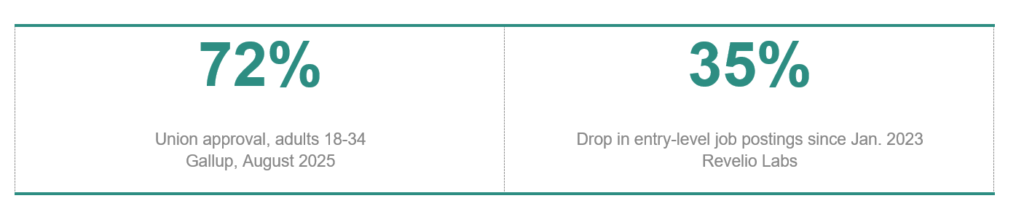
Two numbers describe the same cohort from opposite directions. The most pro-union age group, 72 percent among adults 18 to 34, is also the age group absorbing the sharpest entry-level hiring contraction on record, thanks in part to AI. That is not a coincidence of timing. It is two measurements of the same underlying condition: a generation watching its first foothold in the labor market narrow at the exact moment it has the most favorable view of collective bargaining of any cohort in many years.
TL;DR
- Gallup’s August 2025 poll put pro-union sentiment at 72 percent among adults 18 to 34, the highest of any age group and the strongest run of support in decades.
- Entry-level job postings have fallen by about 35 percent since January 2023, according to Revelio Labs, with the decline concentrated in exactly the age group that already approves of unions at record levels.
- Stanford economists found a 13 percent decline in employment for workers 22 to 25 in AI-exposed occupations, a pattern one of the study’s authors has described as a labor-market shock aimed squarely at Gen Z.
- AI is also becoming its own subject of collective bargaining, with real contract precedent already in place, independent of how the approval-versus-organizing math plays out in any given year.
- None of this guarantees an organizing wave. It does mean the underlying conditions for one are stacking up in a way we should be paying attention to.
Why the combination matters more than either number alone
High union approval, or pro-union sentiment, has existed before without producing an organizing surge, because approval is a feeling, and organizing requires some collective effort. What has historically closed that gap is a concrete, personal threat to job security, not an abstract preference. The AI-driven contraction in entry-level postings is precisely that kind of threat, and it is landing on the one generation already primed to read collective action as a reasonable response rather than a fringe one. A worker who cannot find the first rung of a career ladder, in a cohort that already approves of unions more than any generation has at the same age, is a different organizing prospect than the same worker would have been five years ago.
This is not the first automation shock, but the timing is different
The early 1980s offer the closest historical parallel: manufacturing automation gutted entry-level industrial jobs at the same moment private-sector union density was already sliding from its postwar peak. The workers hit hardest had the least bargaining power to negotiate the transition, resulting in a decades-long shift of power away from labor rather than a union resurgence. The current moment inverts that setup. AI-driven disruption is landing on a generation that already approves of unions at record highs and has already led major organizing campaigns at companies like Amazon and Starbucks. The disruption this time is not hitting workers with no appetite for a collective response. It is hitting workers who have already shown they will act on one.
What is already moving regardless of the timeline
While the approval and hiring numbers get the attention, a quieter shift is further along. The generative AI contract language the Writers Guild of America negotiated in 2023 is now the most cited template for AI-specific bargaining, and Public Services International’s Digital Bargaining Hub has cataloged more than 500 AI-related clauses from unions worldwide. California’s May 2026 executive order on AI and the workforce directs the state’s Labor and Workforce Development Agency to review by October 15, 2026 how collective bargaining is addressing new technologies. None of that depends on whether approval and organizing converge on the same timeline. It is already written into real agreements, and the pattern has a track record of spreading once it takes hold somewhere first.
What this means for employers
None of these belongs on a shelf as a forecast to revisit next year. A few things are worth doing now, regardless of how fast the timeline plays out.
- Treat AI deployment as a labor relations issue, not an IT rollout. Any tool that touches scheduling, discipline, or performance evaluation needs a communication plan before it goes live, not one built in response to a petition.
- Name what is still real about advancement, out loud and often. If the entry-level path is narrowing, silence on the subject reads as confirmation that no path exists at all.
- Build AI governance language into workforce communication before anyone demands it. Human oversight commitments and transparent criteria for AI-influenced personnel decisions are the same categories already appearing in union contract proposals.
- Build internal fluency in AI bargaining concepts now. If you have a union contract in place, this moves from a specialty skill to a baseline expectation for anyone advising on the subject.
The honest caveat
Conditions stacking up for a more pro-union generation are not the same as a wave already underway. National Labor Relations Board (NLRB) election petitions filed by employees fell to 2,100 in fiscal year 2025, the lowest count since 2022, even as approval climbed. The board spent most of 2025 without a quorum and now operates with a Republican majority, a legal and political environment that does not accelerate filings regardless of sentiment. The right way to read this moment is not that an organizing surge has arrived. It is that the structural ingredients for one, a generation primed to act, and a concrete economic threat landing on that same generation, are present together in a way we have not experienced in a while.
Watch the gap, not the headline number. Approval was high before without consequence. What is different now is that the threat closing the gap between feeling and acting is landing on the one generation that was already most inclined to act on it.