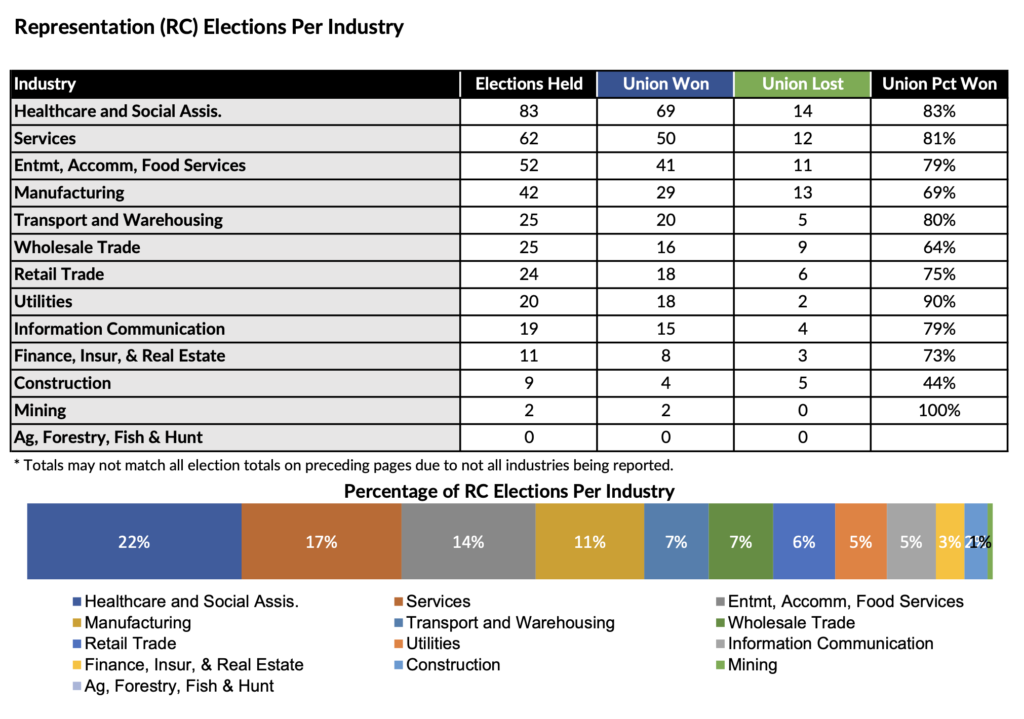
As always, LRIrightnow’s First Quarter 2026 NLRB Review contains more data than any one article can cover, but for the moment, we’re focused on what it can tell us about the healthcare industry. As we explored with the 2025 NLRB Review, this industry’s 88% union victory rate is more complicated than it seems. The same goes for findings in the new report.
To add historical depth to what we observed for healthcare, we also ran queries directly against the full LRIrightNow databases for a five-year comparison covering Q1s from 2021 through 2026. Through that additional context, the newer data points solidify into a longer-term trend.
Five Years Of Data, One Clear Direction
Hospital petition volume has held steady, but that’s not all.
In Q1 2024, unions filed 60 petitions against general medical and surgical hospitals. In Q1 2026, the number was identical with 60 petitions spread across 50 employers. That steady number looks different in context: overall representation petition volume declined 11% over the same period. As we previously noted, worker organizing plummeted in 2025 for many industries, but in hospitals, it has held constant.
What is shifting, however, is the size of the units being targeted. Five years of LRIrightnow database queries–pulled from the General Medical and Surgical Hospitals establishment category–show that the share of hospital petitions targeting units of 10 workers or fewer grew from 26% in Q1 2021 to 37% in Q1 2026. That equates to 9 of 34 petitions in Q1 2021 and 22 of 60 in Q1 2026. Meanwhile, median unit size trended downward over the same period from 35 workers to 30.
Unions are not filing more hospital petitions than they were five years ago, but they are consistently filing petitions for smaller units. For a reason.
The Unit-Size Tactic That Should Be On Every Hospital’s Radar
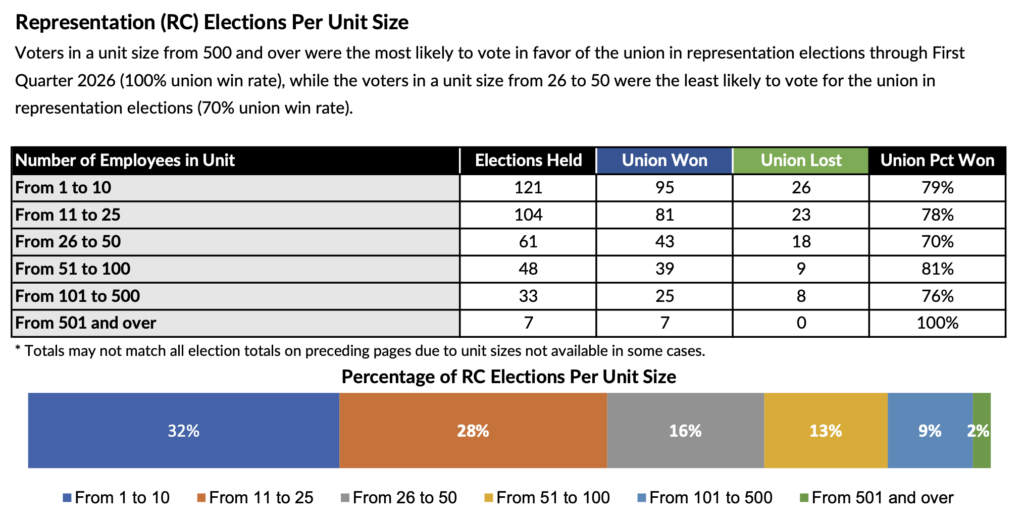
In Q1 2026, one Washington, D.C. hospital appeared in our data with three separate petitions filed by the DC Nurses Association targeting units of 4, 5, and 5 workers. And at a New Mexico hospital, CWA filed for two units of 3 and 4 workers. This is the unit-slicing argument, clear as day.
We aren’t talking about a coordinated campaign driven by a single union, either. In Q1 2026, those 60 hospital petitions came from SEIU, CWA, the Teamsters, AFSCME, UFCW, and several nursing-specific unions. The data reflects how multiple unions have sized healthcare up as an easy target, and they’re using the small-unit strategy with similar results.
The Stakes Are Not The Same As Other Industries
Fragmented bargaining units inside a single health system lead to chaos that unions will further try to capitalize upon. Smaller units can pit workers against each other and create competing contract cycles that consume management time and resources regardless of whether a strike occurs.
When strikes do happen, the consequences extend well beyond the employer. Unions wage costly strikes that don’t produce meaningful results for workers, and they are detrimental to the communities that hospitals serve. Patients face delayed procedures and reduced access to care, and workers walk picket lines for promises unions fail to deliver.
Meanwhile, Big Labor has already moved on to new organizing targets while collecting dues as the dust settles.
What Healthcare Employers Should Gather From This Data
The small-unit trend in healthcare isn’t brand new, but the data shows it is growing more prominent while hospital petition volume holds steady. Multiple unions are independently targeting this industry with similar tactics, and the data shows that this isn’t likely to change.
Unions are looking for the smallest viable unit, filing, and moving on to their next target. That approach doesn’t serve hospitals, the communities they serve, or the workers themselves, but unions aren’t concerned about those consequences. They are focused on their own growth, even if the unit fits in a break room with room to spare.
The First Quarter 2026 NLRB Review is available for purchase ($150) at LRIrightnow.com.