You might have noticed that we love data here. For that reason, we have noticed that the past few months have been ULP heavy. Fortunately, our LRIrightnow databases can help us tell the story of why that’s the case, and as with all complicated stories, there’s more than one reason.
A look at recent years of unfair labor practice charge filings
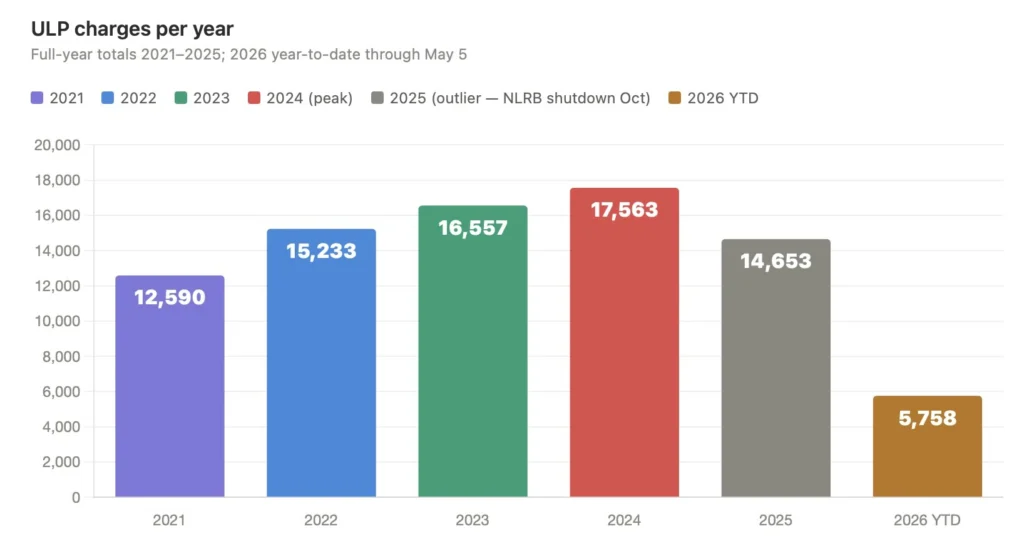
ULP Charges Per Year 2021 to 2026
As this graph shows, ULPs trended up after 2021 and peaked at 17,563 in 2024. Yet in 2025, the annual total shifted backward to 14,653, but that didn’t happen due to an overwhelming sense of goodwill from unions toward employers. Rather, that lower number partially reflects the 43-day government shutdown, which included the NLRB and lasted from Oct. 1 through mid-Nov.
Additionally, the Board’s lack of quorum left it functionally paralyzed for most of 2025, during which regional offices operated without clear direction. During this time, unions didn’t magically stop having grievances, but it’s likely that they held back on filing charges out of uncertainty. That is, they felt apprehension about what the NLRB’s makeup would look like, and how policies would shift, when it became functional again.
The graph also shows a 2026 year-to-date ULP total of 5,758, which puts this year on track to be higher than usual, perhaps even a 17,000 total. That trend was visible in LRIrightnow’s First Quarter 2026 NLRB Review, and it has only continued. Single-day filing volumes are hitting levels that would stand out in any year:
- Jan. 20: 112 charges
- Feb. 17: 145 charges
- Mar. 30: 130 charges
A slightly lower but still steady clip led into Q2:
- Apr. 20: 98 charges
- Apr. 22: 88 charges
- Apr. 29: 87 charges
- May 4: 75 charges
These numbers send a message that HR and labor relations practitioners can’t afford to ignore: 2025 initially looked like good news for employers, who bear a high cost to defend against and counter ULPs. However, this was a temporary lull.
Q2 filings: patterns and cases
More context involves the “new” Board itself. On Jan. 7, two GOP-leaning NLRB members, James Murphy and Scott Mayer, were sworn in. This shifts the Board’s balance 2-1 with Democrat David Prouty entering his dissent era, so the overall makeup of the Board is more employer-friendly than during the Biden era. This might not influence the number of charges filed, although it might shed light on their eventual resolution.
Additionally, Q2 filings are reflecting an ongoing trend: unions filing several charges against an employer during a short period. This deliberately aggressive tactic can be seen below with a twist at the end:
Brunson & Triplett Enterprises
This regional grocery store chain (operating as B&T’s Food Fresh Market) saw UFCW Local 1996 file seven separate ULP charges against it on Apr. 22. Each charge focused on a different Georgia location while alleging refusal to recognize and bargain with the union. The union’s coordinated approach on this date was meant to send a clear signal with a simultaneous paper record.
Brookfield Zoo Chicago
The Teamsters filed a steady drip of ULPs from late Mar. through early May for a total of 13 charges, mostly alleging refusal to bargain. The union used these ULPs to pressure the employer before putting 200 workers on strike in early May. Those picket lines ran for three days before the two sides reached a tentative contract.
The IBT Staff Council
The Teamsters’ staff union is striking back against their employer. On Apr. 22, workers filed eleven duty-of-fair-representation charges against the Teamsters in Washington, D.C. On May 1, three more ULPs involving refusal to bargain followed, showing that Sean O’Brien’s staffers are willing to wield the same tactics against his regime that he is happy throwing at employers.
Apparently, the Teamsters wrote a playbook on ULP filings. Guess they didn’t expect their own staff to read it.
Another trend to watch: who’s getting charged
Another finding from our Q1 and Q2 data can be seen in the below graph, which stretches from 2021-26 and shows the percentage of ULPs filed against companies vs. against unions:
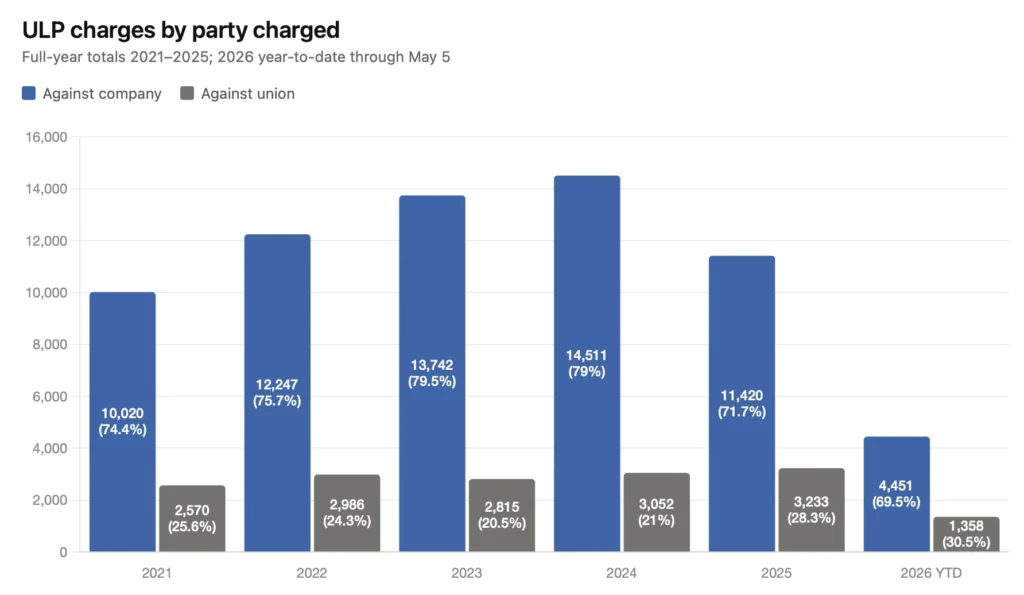
ULP charges broken down by union vs. company
For now, we’ll quickly point out that 2026 reflects an increased percentage filed against unions, which could be part of a trend, given that the 2025 figure is higher than previous years.
Look for us to revisit this subject in another article coming soon. For now, we’ll conclude that it might look like overall willingness to file ULPs is back after a 2025 lull, but for the reasons discussed above, that willingness never really left in the first place.
FAQs
What is a ULP charge?
A ULP (unfair labor practice) charge is a formal complaint, filed with the NLRB, in which a party alleges that an employer or union violated the NLRA. Common employer charges include refusal to bargain, coercive actions, modification of contract, and retaliation. Interestingly enough, union staffers also lodge these allegations against their employers–with a prime example being IBT Staff Council vs. the Teamsters. The NLRB investigates ULPs and decides whether to pursue these cases.
Why did ULP filings drop in 2025?
ULP filings dropped because the NLRB was functionally paralyzed. The Board lacked quorum for most of 2025, leaving it unable to issue decisions or provide clear guidance to regional offices. Unions also held back from filing due to unpredictability in how these cases would be handled. In October, the issue compounded during the government shutdown, and only 308 ULPs were filed during the month, as the mechanism for filing went on pause.
Are ULP filings increasing in 2026?
Yes. Filings are running well ahead of 2025’s pace and could hit 17,000 by year’s end. In early 2026, several single days posted charge volumes that would stand out in any year. The 2025 decrease was an anomaly, and this decade’s overall trend has been upward.