The Faster Labor Contracts Act is built on a false claim about decertifications. Our new research report shows why it falls apart. Read it here.
The U.S. House recently passed the Faster Labor Contracts Act by a vote of 230 to 193 and sent it to the Senate. Make no mistake, this legislation is being pushed by Big Labor, first and foremost Teamsters President Sean O’Brien, who co-authored a pro-labor framework with Sen. Josh Hawley (R-MO). The House bill was introduced by Rep. Donald Norcross (D-NJ).
Employers should know that the FLCA, if passed by the Senate and signed by President Trump, could fundamentally change how first contracts are negotiated, and the results won’t be good for employers or workers.
The FLCA’s Decertification Myth
The bill aims to drastically amend the NLRA by putting strict time limits on first-contract bargaining. After a union wins an election, the employer must begin negotiating within 10 days. If no agreement is reached in 90 days, a federal mediator takes over, and if that fails 30 days later, a government-appointed arbitration panel establishes a binding two-year contract.
No ratification vote will be held, so workers will have no voice on the contract’s terms.
The arbitration panel can set wages, benefits, and other terms that the parties didn’t agree to, and both sides will be stuck with those details for two years regardless of industry, employer size, or contract complexity. Employers who bargain in good faith could still end up with a bad deal simply because the clock hit 90 days.
Meanwhile, it’s no secret that the average time to reach a first union contract sits at 465 days, which shouldn’t be too surprising since these are intricate agreements, and union representatives aren’t known for being the most mild-mannered, logical bunch. Talks get heated. That’s the nature of the game. However, FLCA proponents argue that employers are the ones who are dragging out these talks to frustrate workers into filing decertification petitions and voting unions out.
As our analysis of the data shows, that’s simply not the case.
What The Data Reveals
With heavy lifting from our LRIrightnow databases, we analyzed all 124 decertification elections held in 2025 and linked them to federal contract records from the Federal Mediation and Conciliation Service and a decade of NLRB election data. [Read the full report here.]
Here’s the question we set out to answer: are decertification petitions coming from stalled first-contract talks, or somewhere else?
The data points toward somewhere else. Overwhelmingly, decertifications are happening at workplaces that already have a union contract. For 55.6 percent of the 2025 elections, we confirmed that collective bargaining agreements existed. Accounting for cases with older contracts that predate available records, roughly 84 percent of decertifications occurred where a contract had been in place. Those workers ended their representation after experiencing union membership firsthand, not because a first contract never materialized.
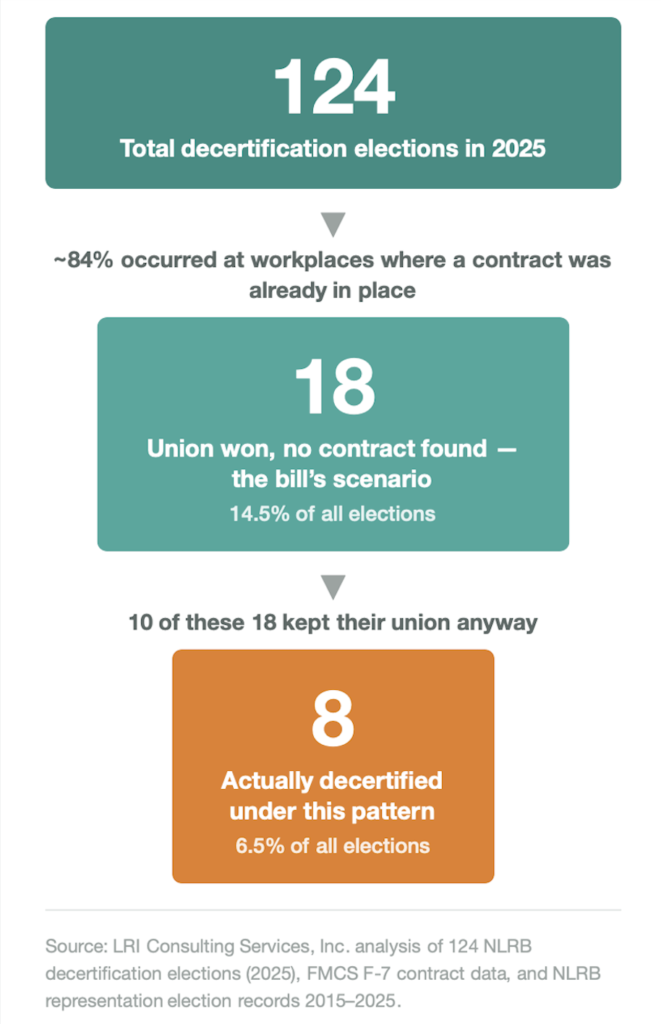
The alleged situation that the FLCA targets turns out to be rare. Only 18 of the 124 elections, or 14.5 percent, fit the claimed pattern of a union winning an election with no contract on record afterward. In most of those cases the union managed to survive the vote. Only 8 led to unions being voted out. That’s 1 in 15, or 6.5 percent, of all decertification votes in 2025.
The timing tells the same story. In 17 out of those 18 cases, the median time from the union’s election win to the decertification petition was 581 days, or roughly 19 months, well beyond the industry-wide average of 465 days to reach a first contract. These workers weren’t filing petitions in the first frustrated months of a stalled negotiation. They gave the process a full run and decided they had seen enough.
What Big Labor Doesn’t Want Workers To Know About The FLCA
The FLCA is being pushed to stop a pattern the data does not show. This is legislation built around falsehoods from unions, which are deflecting from demands that employers simply cannot sustain while staying in business. If the bill passes the Senate, don’t put it past union leaders to press arbitrators to satisfy their demands within binding contracts, which will not be subject to workers’ ratification votes.
Read our full analysis of the datasets, which shows why the FLCA narrative doesn’t hold up.