What’s in their feed: Artificial Intelligence (AI) at work has become an organizing issue, and it is showing up in different ways.
For a couple of years, AI in the workplace was an IT story and an efficiency story. Now it is a union organizing story. Two examples of that shift crossed my desk this week, and side by side they tell you where this is going.
The campaign: a face and a grievance
The first example is a call to sign a petition. It comes from United for Respect, a worker advocacy group, under the banner Tech for Respect. (The page is an advocacy campaign and the worker accounts on it are unverified.)
The featured employee is an overnight associate in North Spokane named Ava. She says a scheduling algorithm now runs her shifts, assigning eight hours of work in four, and that when she asks how the numbers get set, nobody can tell her.
They have a name for the issue: Robot Bosses. Set aside whether Ava’s math checks out and look at the build instead. A real worker. A concrete grievance. A phrase that sticks. A pledge to sign. That is the oldest organizing formula there is, and it is pointed straight at AI. The complaint is the algorithm itself, the productivity tool the employer chose to implement.
The research: a script for the conversation
The second piece sits underneath campaigns like Ava’s and hands them information and words for their argument. It comes from the Luddite Lab, a project of the Distributed Artificial Intelligence Research Institute (DAIR), a group by ex-Google people openly on a mission to help workers fight AI at work.
The method is simple and effective. They take the things management often says about how AI will affect the job, then walk through each one and reframe it as a myth. Here is the core of it:
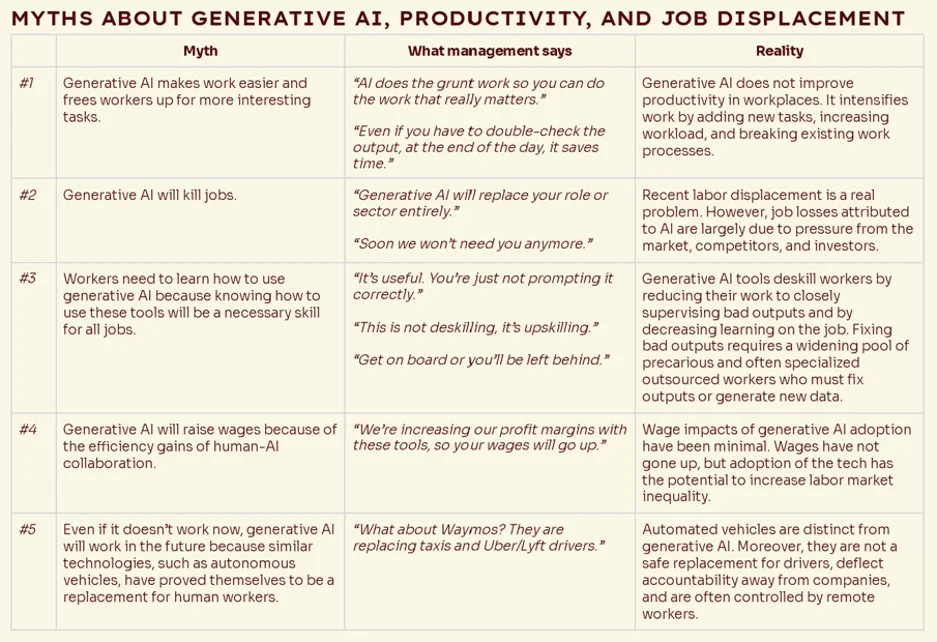
From the Luddite Lab primer, “Myths About Generative AI, Productivity, and Job Displacement.”
Read the middle column again. Those are not strawmen. They are the lines a lot of us might use, and mean sincerely, walking a team through a new tool implementation. The primer reframes each as a myth to be punctured, and the answers in the third column are doing legit argumentative work, but they lean into the fear factor. Job losses get pinned on market greed. Productivity gains are waved off as hype. Each rebuttal picks the reading least flattering to the employer and presents it as settled fact.
The management lines are not dishonest, but they have been cast as the villain and play on employee concerns with an eye towards organizing. (Read the whole thing: full version, executive summary.)
Why the two together matter
The campaign brings the face and the feeling, Ava and her Robot Boss. The research brings the language and the rebuttals. So, the worker who walks in angry about the algorithm now walks in with an answer ready for whatever reassurance you have prepared.
And the grievance they picked is shrewd. Control over implementation: who decides which technology runs the floor. Watch for organizing in shops without a union. If you have a union, expect a union request for a worker-led technology committee, seeking a joint say over which tools get deployed, and language in the contract.
What you do about it
Almost none of this gets won with a rebuttal memo. Some of what the worker side says is just true, and the employer who denies that reality risks forfeiting credibility on the rest.
You earn worker credibility most effectively by being transparent. Explain the impact of technology in plain language, to the people working under it.
Listen to your own rollout language and ask, honestly, whether it sounds like their script. Get ahead of the control question before it shows up as a demand or a campaign.
Read the case studies on the Luddite Lab site. They make three key arguments:
- The fight begins long before the bargaining agreement and does not end when it is signed.
- It’s about AI, but it’s not about AI.
- It’s about bringing back control and oversight to workers.
Let’s keep this going
This is the heart of the session Patricia Garland and I are hosting July 15, AI and Trust in Labor Relations, inside the empowER™ community, the free peer employee relations network run by HR Acuity, where I run the labor relations forum. Join at hracuity.com/empower-community; session details and RSVP are here. Please join us.