LRIRightNow’s 2025 NLRB Review contains a treasure trove of data on election volume, unit sizes, union decertifications, and union win rates in a variety of industries. As noted in our roundup of standout statistics, one eye-catching tidbit (on Page 16) reveals that unions won 88% of petitions within the healthcare industry. Of the 306 healthcare elections held, unions won 269 elections and lost 37 of them.
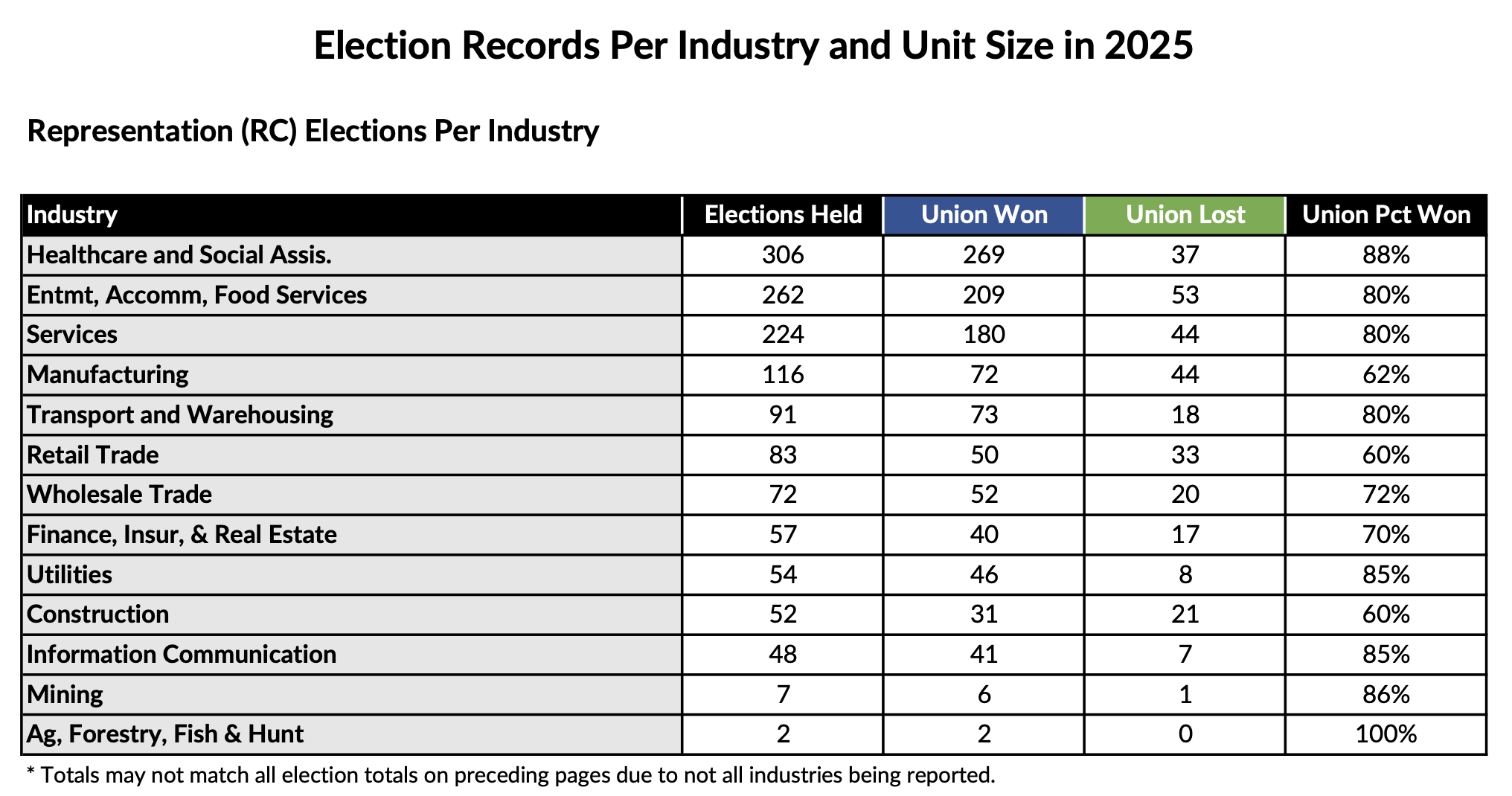
Let’s get this out of the way first: Yes, that’s a higher percentage of union wins as opposed to 60% union wins in the construction and manufacturing industries or 80% in transport and warehousing. The total number of non-healthcare elections averages out to a 75% union win rate in 2025.
Yet for the healthcare industry, plenty of context sits behind that 88%.
Why Healthcare is Particularly Attractive to Unions
The healthcare industry faces unique challenges, which accelerated during the pandemic and haven’t eased up yet. These difficulties include safety concerns and staffing shortages that were exacerbated by a mass exodus of workers from the field. Unions are eager to capitalize upon resulting frustrations, including on salary issues, which might be compounded by the end of pandemic-focused waivers and emergency funding. Additionally, recent government policy changes are likely adding chaos.
As a result, unions feel like they have a lot of leverage in healthcare settings and pursue their targets as aggressively as possible, such as by slicing and dicing bargaining units in ways that are favorable to winning elections. The usual suspects in these drives include SEIU, UFCW, and many nursing unions, and in 2025, several unions that you wouldn’t ordinarily think of when it comes to healthcare–IAM, AFSCME, IBEW, AFT, and the Teamsters—attempted to poach healthcare workers.
What Are the True Effects of Unions in Healthcare Workplaces?
Not fantastic, for workers or the communities that they serve.
As an example of one union’s effects on a metropolitan area, The Center for Union Facts released a Feb. 2025 report pointing toward worse patient outcomes for Los Angeles hospital systems where SEIU has organized nurses. This study should be spread far and wide, since SEIU infiltration correlates with a disproportionate percentage of 1-star hospitals (35.3%) compared to all LA hospitals (11.8%). Also tellingly, zero SEIU-unionized hospitals in the city held a 5-star rating.
Additionally a 2023 Journal of Nursing Administration study found that union-represented nurses were less likely to report turnover, but they were more likely to experience job dissatisfaction. In other words, unions don’t really make nurses any happier about being there.
That is to say, there are certainly less invasive and less expensive ways to address retention than workforces taking the gamble of union representation that leads to only broken promises in return.
High-Profile Strikes Create a Perception of Union Dominance
Healthcare workplaces are environments in which strikes are crippling to both the organization and the community. As a result, these picket lines are extensively showcased by the press. One need only look at recent reports on the New York State Nurses Association’s current strike, which is now in its third week. 15,000+ nurses walked off the job to strike against three major hospital systems. Both sides planned for a weeks-long event, and the hospitals spent at least $100 million on hiring replacement nurses.
NYSNA’s demands include considerable salary increases, i.e. $220,000 compared to Montefiore’s current average of $165,000. This kind of attention-seeking pressure does not guarantee results for union members, who will almost certainly be disappointed by false union promises on what can happen at the bargaining table.
Case in point: Healthcare unions have repeatedly waged extended strikes without meaningful results during the Kaiser Permanente labor saga.
These high-profile strikes are rarely beneficial for workers, and they are detrimental to the communities that hospitals serve. Where is Big Labor, meanwhile? They’ve likely already moved onto organizing new targets.
Reality check: Healthcare Employers Can (and Should) Push Back
Because healthcare strikes are so visible and impact the community, there’s a default belief that unionized healthcare workforces outnumber non-unionized ones. Yet that’s far from true, and all is not lost. Unions do lose healthcare elections, and they’d probably lose many more if more hospitals chose to take a union campaign to election rather than voluntarily recognizing a union.
These strikes aren’t good for workers, hospitals, or the communities they serve. Workers receive empty promises and walk picket lines without meaningful gains. Hospitals divert millions of dollars that could improve patient care toward replacement staffing instead. And communities suffer when healthcare access is disrupted and patient outcomes decline.
The 88% union win rate in healthcare is attention-grabbing, but it isn’t the end of the story. Healthcare employers can successfully combat organizing drives and foster the kind of workplace culture that benefits both staff and the patients they serve. That’s the case when hospitals are willing to search for the right approach and will engage directly with employees about what unions can and cannot deliver.