
- Emptied their wallets into political campaigns, for an as-yet moderate return on the investment.
- Allowed their pension funds to lapse into desperately low funding levels.
- Squandered resources and damaged their reputations by waging intense internal wars.
- Attempted hostile takeovers and executed several mergers.
- Continued the decades-long trend of shedding membership, at least in the private sector.
- Repeatedly found themselves working against the wishes of their own membership.
Unions mirror government in its most significant attribute – they are both fixated on self-preservation and growth, far beyond actually representing the people they supposedly “work for.” They also understand each other, more so than most of their constituents understand them. 



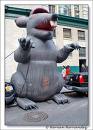
“Now, it is hard for unions to make their case for workers to join [a union] based on bread and butter issues. Unions are businesses and they are using corporate campaigns because [the campaigns] do not require them to win over employees. [Using] corporate campaign tactics unions win 90 percent of the time.”
At the risk of sounding like a broken record, today’s environment may even be a bit scarier than when EFCA was alive and well. Because of our daily involvement in fighting union organizing campaigns (according to DOL reports our firm consults in more than twice as many campaigns as our next closest competitor) we hear not just what the high-profile labor leaders are saying. We hear from those in the trenches – the union organizers brought in to foment unrest in a company, the leaders of union locals initiating such action, the union sympathizers within those companies. We see their shifting tactics and new tricks. 
Prior to the Obama Administration, the NLRB maintained an online database of all card check recognitions and any subsequent union decertification elections. The NLRB, however, stopped updating this information last spring. Foundation attorneys recently demanded the NLRB to update the database regularly, and NLRB Chairman Wilma Liebman responded last week. Although she blamed the General Counsel’s office for the neglect, she stated the agency would post new information monthly going forward.
The data was revealing at several levels. First, it indicated just how often companies are pressured or succumb to allow organizing via card check. Perhaps more significant, it highlighted how often those same unions were sent packing via secret ballot after having been ensconced using the non-democratic card check process. ********** Only In A Union This tidbit contributed from Winston & Strawn, LLP, attorney William Miossi:
A Federal Labor Relations Authority administrative law judge ruled that NLRB General Counsel Ronald Meisburg must bargain with the National Labor Relations Board Professional Association with respect to a consolidated unit of approximately 130 NLRB attorneys. Meisburg has refused to bargain with the union over the consolidated unit in order to obtain court review of the consolidation, which he argues violates the NLRA’s separation of board and general counsel responsibilities. (NLRB, FLRA ALJ, No. WA-CA-09-0326, 11/18/09)
**********
LRI’s Brand New Online Supervisory Training Program
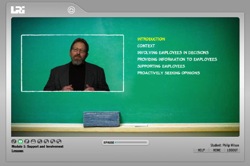
Your front line supervisors are the number one key to a solid union defense, and a positive workplace.
Nothing takes the place of properly trained front line managers and supervisors, but in today’s hectic business environment, we’ve never asked our front line leaders to do more with less. How in the world can you take the time to pull them from their jobs, and provide training that really makes a difference! Our new Online Active Interval Training (OAIT) is the answer. OAIT includes: 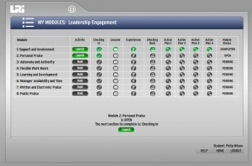
“‘Green jobs’ is a phrase being used to describe work that is environmentally friendly, both inside and outside the construction industry,” Worth told the forum. “However, there is no agreed-upon definition. Currently, organized labor is attempting to define ‘green jobs’ as positions held by workers that receive special green training through union-only apprenticeship programs.”
Hate to say “we told you so…”
Given that narrow definition, literally all government contracts would be unionized merely by categorizing the work as a “green job.” But why stop there? Given the enviro-whacko aims of this administration, EPA regulation could apply that definition to permitting for any construction project. “Organized and certain special interest groups claim that only union apprenticeship programs can properly train workers to build green projects,” Worth said. “However, these claims are nothing more than an effort to monopolize the construction workforce on green building and other construction projects. Most green building techniques involve simple architectural changes or the use of environmentally-friendly building materials, which requires workers to learn skills that can be taught through both union and nonunion training programs.”
********** Employee Relations Tip Of The Month The Power of Praise Mark Twain once said, “I could live for two weeks off one good compliment.” As a manager, do you take the time to praise and recognize your employees when they do a good job? What are you doing to fully leverage this powerful motivational tool? Timely, sincere, specific praise is one of the most important things you can do to get better results out of your people. Here are some easy, low or no-cost actions you can take now to increase engagement by leveraging the power of praise and recognition:
- Make recognition a standard agenda item for your team meetings. Either begin or end each meeting by dedicating a few minutes to allow team members, yourself included, to publicly praise or recognize another person. Ask your boss to attend a meeting during which you thank your employees for their specific contributions.
- Use internal communications such as the company intranet, newsletters, or a “Wall of Fame” to showcase employees who have been recognized for their outstanding achievements or contributions.
- Organize a cross-functional team of employees who are chartered to develop a Peer Recognition Program. Provide them with appropriate boundaries (i.e., monetary limits, etc.) and get out of their way!
- Write personal ‘Thank You’ notes to employees when they do something that warrants recognition or praise.
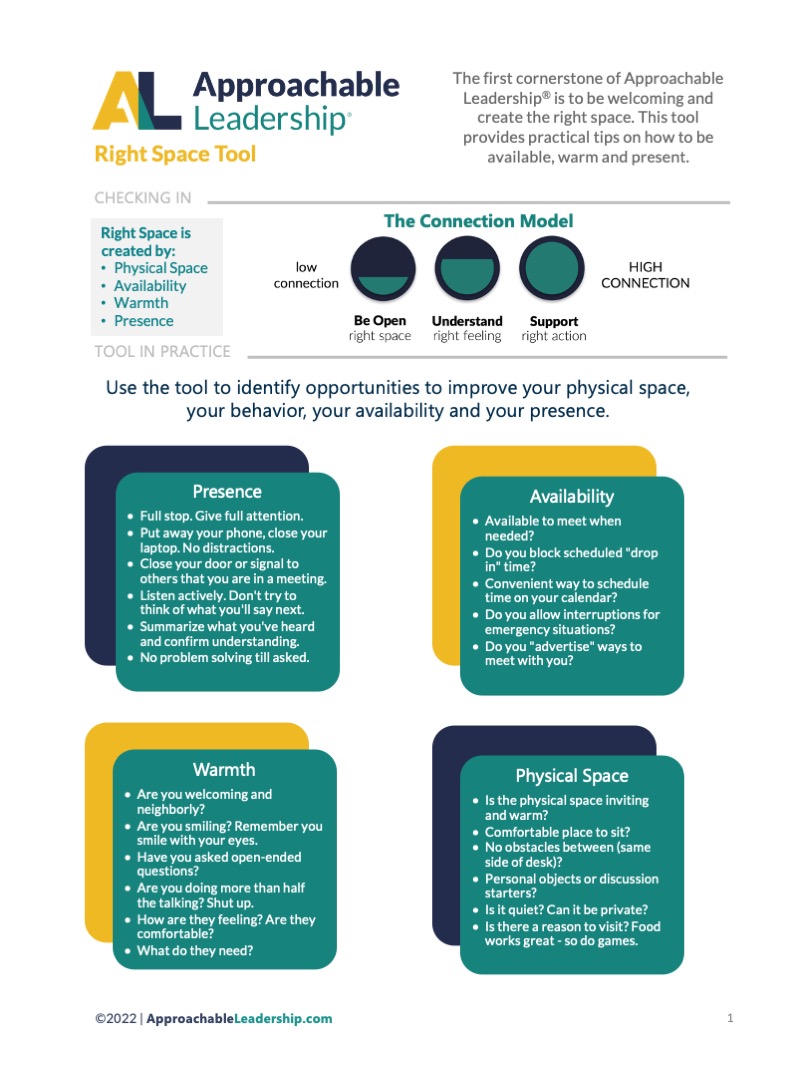
To learn more about how to improve the morale and engagement of your employees, check out LRI’s Online Supervisor Training. Hat Tip to Eric Vanetti of VantagePoint Alliance ********** The Sound of Silence Heard of Bernie Madoff? Of course you have. Got caught running a huge Ponzi scheme. 

Richard Berg
Not everyone was happy with Local 743’s new direction, including some of the newly-elected officers. They agreed to run with Berg on a reform platform that included reducing the salaries of overpaid union officials. But they demanded higher salaries once they were in office. When members complained that some union representatives weren’t doing their job, Berg investigated the complaints, took the cases to the union’s Executive Board, and those union representatives were terminated. Unhappy at the financial reforms and the demands for accountability of union staff some Local 743 officers teamed up with Berg’s opponents in the Teamster hierarchy. They filed internal union charges falsely claiming that Berg had failed to present the terminations and other union matters to the Executive Board. Not a single one of the charges alleges that Berg or any other Local 743 reformer took a penny for personal gain.
Berg is going through the internal appeal process, but our bet is that he will be forced to head to federal court. ********** 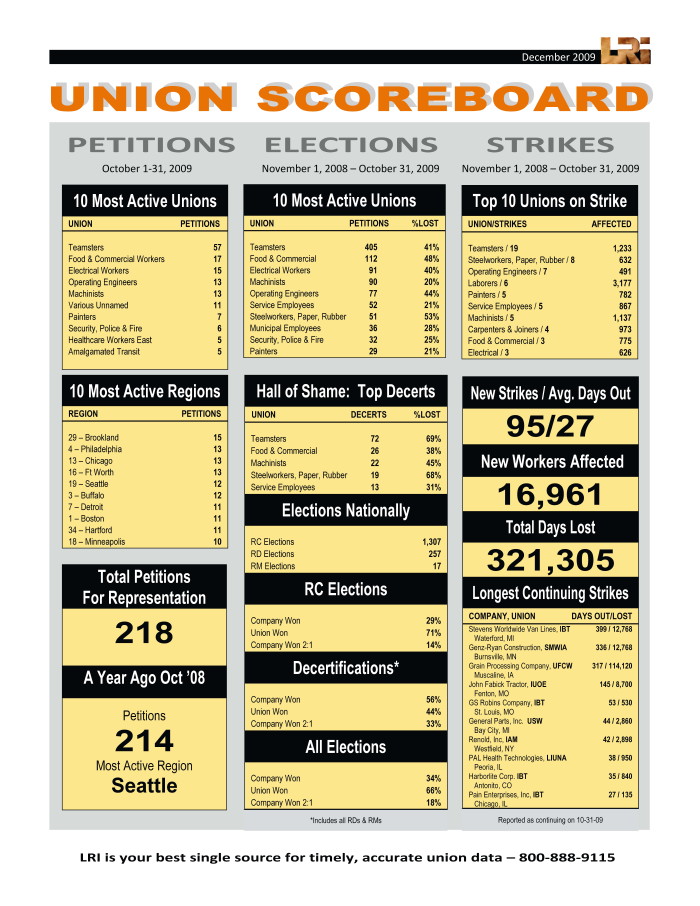
View this month’s scoreboard (archives also located here).
Download a PDF of this month’s scoreboard.
********** New Union Argument To Entice Potential Members For Big Labor, health care is not about health care. Health care is about finding new ways to drive people into union membership. We’ve highlighted already the direct means of categorizing more health care employees as government employees, which makes them easier to organize. The latest closed-door deal-making aimed at securing Big Labor’s vote for the current version of the bill provides another, albeit more indirect, means: exemption from the “Cadillac tax” on more expensive employee health plans. This 40% tax on certain plans was designed to help pay for the bill. The compromise is a series of exemptions which, if political operators are shrewd enough, will become permanent. According to the Wall Street Journal, this means “the 87% of Americans who don’t belong to a union will now foot the bill for a $60 billion giveaway to those who do.” “What, you don’t belong to a union, so your benefits are or may be subject to this tax? Wow – maybe you should join a union!” That will be the new weapon in the union organizer’s arsenal. The tax exemption is not the only give-away to unions. Others include:
- Companies with fewer than 50 workers would not be required to provide their employees and their families with a government-approved insurance plan. However, for the heavily unionized building trades, that threshold was lowered to just five employees.
- Most employers will have five years to bring the insurance they offer into compliance with government specifications, including a minimum package of benefits. Not only will employers pay more for insurance, but workers could find their contribution going up as well. But once again, if the insurance is part of a union-negotiated contract, employers will not have to make any changes until after the contract expires.
- Beginning in 2017, all union workers would be permitted to buy coverage through the government-regulated exchanges, where insurance is expected to be less expensive. The original House and Senate bills limited access to the exchanges to small businesses, individuals and the uninsured, out of concern that a wider buy-in would undermine the system of employer-provided health care for the vast majority of Americans.
Heath care as an organizing tool. Who’d have thought? ********** FREE! Union Organizing Defense Review & Vulnerability Audit 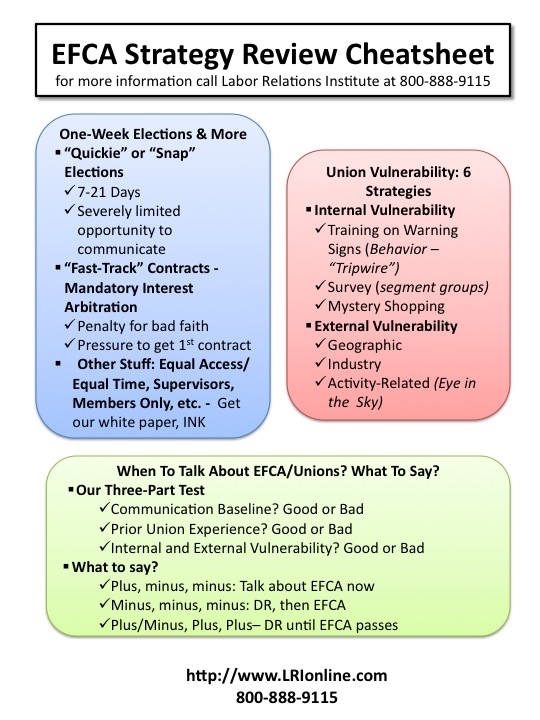
**********
Union Corruption Top Ten of the 2009 For our corruption highlight in this issue, we’ll share the National Legal and Policy Center’s list of the ten most egregious union corruption stories of last year. 10. Reports conclude EFCA is gift to unions. 9. New York City contractor, consultant sentenced for scams. 8. Equity fund CEO in Chicago indicted in pension scams. 7. SEIU browbeats California health and home care local. 6. Labor Department rescinds Bush-era union transparency rules. 5. Studies conclude union pension assets lag behind liabilities. 4. Service Employees union becomes an adjunct of the federal government. 3. Benefits administrator in siphons off $42 million from NYC Sandhogs. 2. Upstate New York unions lose hundreds of millions to Madoff feeder funds. 1. Obama Treasury Department arranges union stake in GM, Chrysler. Quite a weighty list. Read the article for additional details, and additional examples of unions and union officials at their “best.” ********** Labor Relations INK is published semi-monthly and is edited by LRI Consulting Services, Inc. Feel free to pass this newsletter on to anyone you think might enjoy it. New subscribers can sign up by visiting: https://lrionline.com/free-stuff/newsletter-signup/ If you use content from this newsletter please attribute it to LRI Consulting Services and include our website address: www.LRIonline.com Contributing editors for this issue: Phillip Wilson, Greg Kittinger, Shaun Fanning You are receiving this email because you subscribed to receive our labor relations newsletters and updates. You can manage your email preferences by clicking the link at the bottom of any of our email communications. NOTE: if you are using Internet Explorer v. 6, read the text version, as the html will not load properly in IE6. We recommend upgrading to IE7.